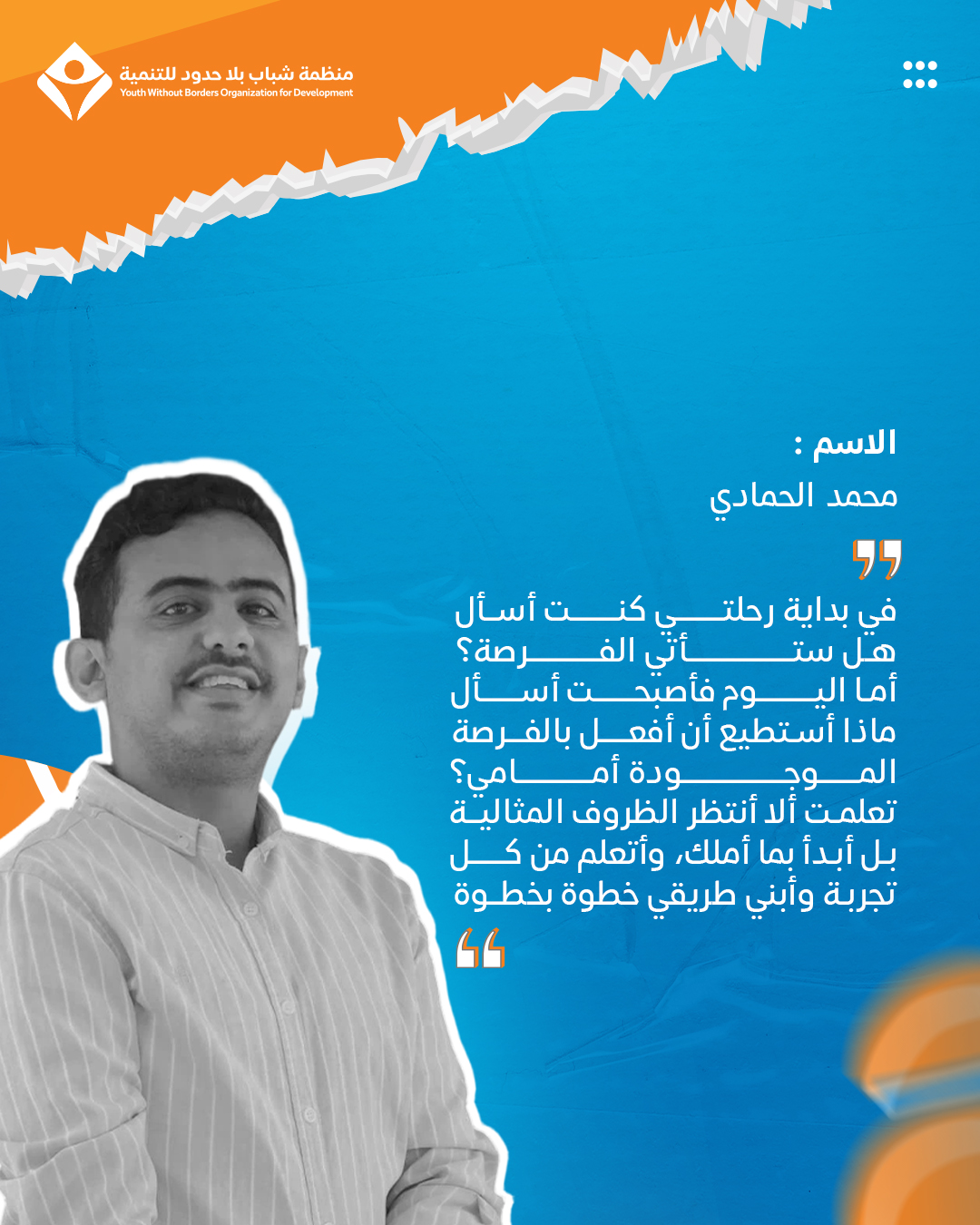
After graduating from university, Mohammed Al-Hammadi began his journey like many young people in Taiz: searching for a job and trying to build his future amid difficult economic and professional conditions. He started in administrative roles, then gradually moved into work with organizations and youth initiatives, learning from each experience and looking for a space where he could develop himself and make a meaningful impact.
The path ahead was not always clear, and the opportunities were limited. There were periods when he worked long hours, learned new skills, and participated in activities and initiatives, while the results did not come as quickly as he had hoped. One question often stayed with him: Am I really moving forward, or am I going in circles?
Mohammed decided not to wait for perfect circumstances. He began treating every opportunity as another step in building his experience. He joined youth initiatives, met people from different fields, and took on greater responsibilities in the projects he worked on. With each experience, he discovered new abilities in himself.
Over time, his focus expanded beyond simply finding a job to youth and community issues, the environment, entrepreneurship, peacebuilding, and community mediation. There was no single moment that changed his path. Instead, it was a series of small experiences: a responsibility given to him by someone who trusted him, a colleague he learned from, a problem that pushed him to search for a solution, or a word of encouragement at a moment when he needed it.
This journey changed the way Mohammed saw himself. He no longer viewed himself as a young person waiting for an opportunity, but as someone capable of learning from what was available, building his own path step by step, and helping others do the same.
He began supporting other young people in applying for opportunities, preparing their CVs, developing their ideas and projects, or simply sharing information that could open a new door for someone else.
Today, Mohammed believes that young people in Yemen do not lack ideas or motivation. What many of them need is a first opportunity, trust, and a space where they can prove what they are capable of.
He still considers himself at the beginning of his journey, continuing to learn, experiment, and look for new opportunities. But the question that once followed him, “Will an opportunity come?” has now become: “What can I do with the opportunity in front of me?”
His message to young people reflects what he has learned along the way:
“Do not wait for the perfect opportunity to come to you. Start with what you have, keep learning, and build your own opportunity.”